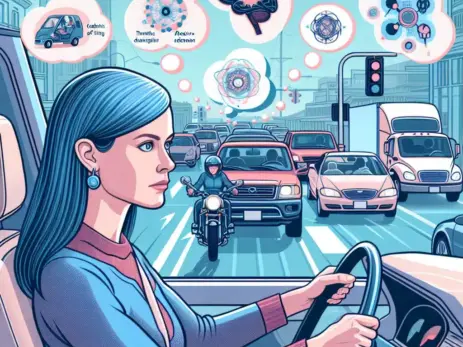
It is now online the article: “The prevention of road accidents in non-expert drivers: Exploring the influence of Theory of Mind and driving style.” by Raffaella Nori, Micaela Maria Zucchelli, Pierluigi Cordellieri, Alessandro Quaglieri, Massimiliano Palmiero, Paola Guariglia, Marco Giancola, Anna Maria Giannini, and Laura Piccardi, published in Safety Science. This article aims to examine the connection between Cognitive and Affective Theory of Mind (ToM) and Driving Style in road safety. We hypothesize that a higher level of ToM corresponds to a greater ability to avoid accidents and to assume virtuous driving behaviour. We investigate how ToM impacts driving behaviour, directly correlating with assessing potential accidents’ probability and severity. 207 non-expert drivers, including 164 females, participated in assessing Cognitive and Affective ToM through two tasks. They also completed self-measured questionnaires to assess their driving style and behaviours. In addition, they evaluated 12 videos depicting cars, motorcycles, trucks, and pedestrians to determine the probability of a road accident and the level of danger in each scenario. The results of the mediation models clearly indicate a relationship between ToM and the reduction of road accidents. Specifically, Cognitive ToM plays a crucial role in assessing the probability of risky and dangerous situations related to Risky and Angry Driving Styles. However, it was observed that Cognitive ToM does not significantly affect the prediction of actual driving behaviours. Our results suggest the importance of creating drive-assistance systems considering both the Cognitive ToM and Driving Style to reduce road accidents among non-expert drivers.
The prevention of road accidents in non-expert drivers: Exploring the influence of Theory of Mind and driving style
More from the Blog
Editorial: Effects of physical exercise on brain and cognitive functioning, volume II
It is now online the editorial: Editorial: Effects of Physical Exercise on Brain and Cognitive Functioning, volume II by Soledad Ballesteros, Laura Piccardi, and Joshua Oon Goh, published in Frontiers in Human Neuroscience. The editorial introduces Volume II of this research topic, which focuses on the effects of physical activity on the brain and cognition. […]
Comparing Immersive and Non-Immersive VR: Effects on Spatial Learning and Aesthetic Experience in Museum Settings
Comparing Immersive and Non-Immersive VR: Effects on Spatial Learning and Aesthetic Experience in Museum Settings A recent article published in Brain Sciences "Comparing Immersive and Non-Immersive VR: Effects on Spatial Learning and Aesthetic Experience in Museum Settings" by Laura Piccardi, Marcello Massidda, Laura Travaglini, Sofia Pescarin, Marco Giancola, Massimiliano Palmiero, Matteo Deflorian, Sabrina Apollaro, Roberta Lista, and Raffaella […]

Measuring spatial navigation in children and adolescents: a systematic review
Dr N. Martin-Pozuelo presented in the poster session a work entitled ' Measuring spatial navigation in children and adolescents: a systematic review.' by Martin-Pozuelo, N; Solis-Garcia, M; Carballo-Costa, L; De Las Cuevas-Teran, I; Piccardi, L; Robles-Ga...