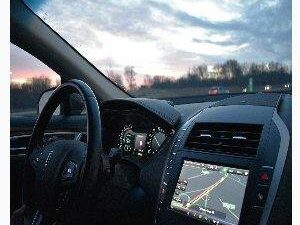
GPS Digital Nudge to Limit Road Crashes in Non-Expert Drivers
{{brizy_dc_image_alt entityId=

It is now available online the article  

GPS Digital Nudge to Limit
Road Crashes in Non-Expert Drivers

 by Nori, R., Zucchelli, M.M., Giancola, M., Palmiero, M., Verde, P., Giannini, A.M. and Piccardi, L. published in Behavioral Sciences
as part of the Special Issue Road Crash Injury and Driver Behavior.

It reports data on the use of the GPS nudge and its relationship with spatial ability, together with its function to support non-expert drivers, in order to reduce the number of road crashes. Our results reveal that the higher the spatial skills are, the greater the GPS use is, and that drivers who use GPS improve their sense of direction. Moreover, people with high visuospatial abilities use GPS more extensively. Finally, young drivers do not consider the GPS aid to be useful when they have no time pressure. Our results have been discussed by taking into account the familiarity-and-spatial-ability model

More from the Blog

{{brizy_dc_image_alt entityId=
Giant chess game enhances spatial navigational skills in 6-years-old children: preliminary findings
It is now online the Article Giant chess game enhances spatial navigational skills in 6-years-old children: preliminary findings by Alessia Bocchi, Massimiliano Palmiero, Filippo Persichetti, Maurizio Matteoli, Cecilia Guariglia and Laura Piccardi publish...
{{brizy_dc_image_alt entityId=
The Verbal Judgement Task: Normative data of verbal abstract reasoning in a sample of 18- to 40-years old
It is now online the final published version of the Article "The Verbal Judgement Task: Normative data of verbal abstract reasoning in a sample of 18- to 40-years old.”by Massimiliano Palmiero, Antonella Di Vita, Alice Teghil and Laura Piccardi, published...
{{brizy_dc_image_alt entityId=
Malevolent Creativity and Cognitive Style: The Mind Behind Harmful Ideas
This article provides an in-depth analysis of the research published in Frontiers in Psychology by Pierpaolo Zivi and colleagues, titled "Field dependent-independent cognitive style as a predictor of malevolent creativity: a multifaceted approach". The study explores one of the most fascinating and unsettling aspects of the human mind: malevolent creativity, the ability to generate original ideas with the […]
Scroll to Top